Blank Bottle
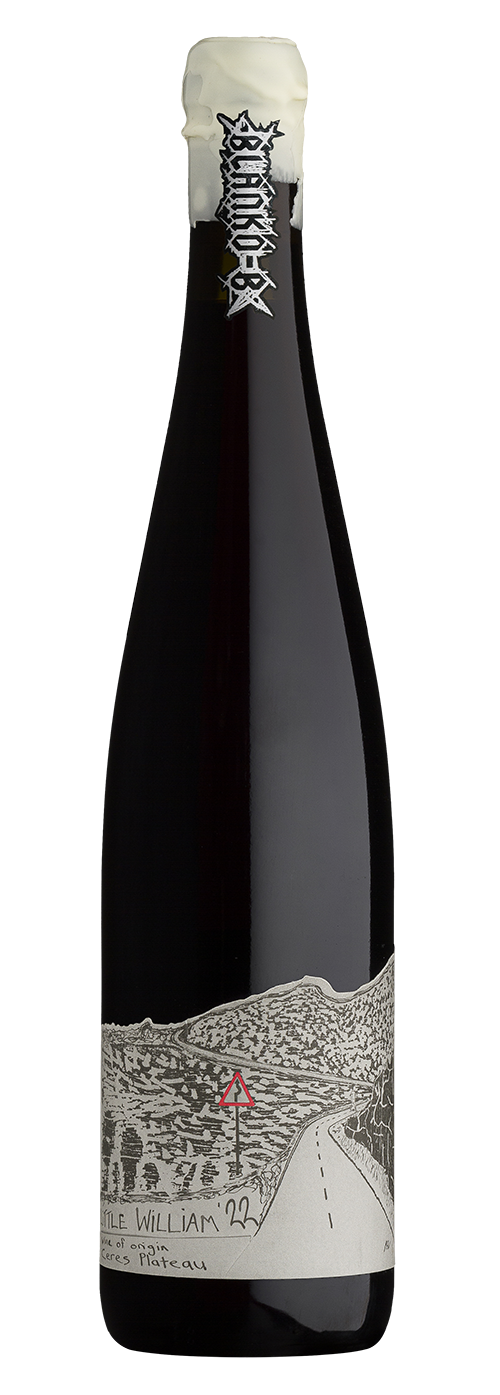
Little William 2025
Little William 2025
750ml
Couldn't load pickup availability
Little William is growing up. With the addition of a new vineyard called “Ankerblok”, the trajectory of the wine is changing slightly. Today we are releasing the 2025 vintage - The future for Little William.
This wine now combines fruit from the original Shiraz vineyard, “Rivierblok”, with fruit from the newly established “Ankerblok” (read the story below). And because of that, you can expect a shift. More feminine, more defined and more spicy. A shift in exactly the direction we hoped for.

Then came 2025. A banger of a year when it comes to quality.
When you combine a remarkable vintage with an epic site - something special happens.
This wine is a great example of what Shiraz at 750 m above sea level can do. The wine is named after my chance meeting with a little boy called William on the Witzenberg mountains. It’s been a fascinating story from the start, but became even more bizarre at the end of last year, with another chance meeting.
The Story:
In January 2016, I was driving back from a tiny little vineyard in the Koue Bokkeveld (Ceres Plateau). Cruising along at the 100km/h speed limit, I came to a very winding stretch of road leading towards the Witzenberg pass. Suddenly, for a split second, I thought I saw something in the middle of the road. I had just come through a super sharp bend and had to jump on the brakes with both feet. When I finally got my 470 000-km-on-the-clock Toyota to stop, there, on the white line in the middle of the road, stood a little blonde boy.
I guessed him around a year and a half old. He was in his nappies and had a white T-shirt on, perfectly camouflaged on the white line. Unsure of what to do once I'd taken him out of the road, I thought it a good plan to prompt him and see which direction he takes off in (with myself of course right behind).
About 200 meters further along the road he (we) crossed a little bridge heading towards the other side of the canal. He turned up a dirt road which led to a farmhouse about 300 meters up a hill. Keeping up to his snail-like pace, we arrived at the house more or less 10 minutes later (in my experience with farm dogs, it wouldn’t have been wise to carry him). When the gardener saw us approaching, he called out to a woman at the house and judging by her reaction, she must’ve been his mom and he must’ve been missing for a while. It was a bit of an emotional and chaotic environment so, knowing he was safe, I just turned around and left without introducing myself.
So each time I present a tasting with Little William wine as part of the line-up, I get the same question: “Why is it called, Little William?”, followed almost without fail by: “What does the family have to say about you calling a wine, Little William?” My answer is always the same: “I never went back, they don't even know the wine exists. But I am convinced there will be this one day where I’d be sitting at some local bar in Knysna, drinking a beer all by myself when the young guy next to me turns to me and introduces himself as William from Ceres." And I’ll be able to tell him: “Eendag, lank, lank gelede het hierdie oom jou lewe gered!”
For 4 years I had the privilege of telling the story of little William. Until last year. When Chapter 2 happened. In November, we took our youngest son for a minor operation at Panorama Mediclinic, Tygerberg, Cape Town. The lady at reception looked at us with a puzzled look on her face. We later learnt that there had been a mistake on the paperwork and they were under the impression that he was an adult. They had subsequently booked him into an adult ward. The man next to him had drunk a cup of coffee at 6:00am that morning with milk in. His operation therefore had to be postponed and he obviously missed his theatre time slot. He had to wait almost the whole day for the next slot. He and Sebastian eventually left for the theatre at more or less the same time.
I went to get us a cup of coffee, and as she always does, Aneen started making conversation with the milk-in-the-coffee guy’s wife. On my return Aneen said: ”They are from Ceres, tell her the little William story.” I cringed, thinking: "Why would I do that??" I tried to let her comment slide and filled the awkward silence with useless words. We carried on with the small talk and she ended up telling us that she is a vet and her husband is a farmer. “Where do you farm in Ceres?”, I asked. “In the Witzenberg mountains, on a farm called Blah-blah-blah”, she answered. And, as you’ve probably guessed by now, that was the name of the farm where I dropped little William that morning.
It started dawning on me that it might be my Knysna-bar-thing moment happening in a totally bizarre, different way. “Do you have a son called William?” I asked. “No”, she replied, “but my nephew is called William and they live on the same farm, in the house next to the road.” We did the sums and he would’ve been exactly 1 and a half years at the time. So it turns out it wasn't a beer-in-hand pub in Knysna, but a coffee-in-hand hospital in Cape Town. I should've listened to Aneen right from the start... so I told her the whole story and she phoned her sister-in-law. “Did you ever lose William on the farm?” she asked (I don’t think that’s the type of story you volunteer to tell your extended family if not prompted). “Yes”, she said. “There was this one day…”
Information
Varietals: Syrah
Vintage: 2025
Region: Ceres Plateau
Ward: Visgat - Koue Bokkeveld
Vineyard: 750 meters above sea-level Ceres Plateaux grapes in sandstone soil. Vines trained according to the vertical shoot positioning method on a traditional 3 wire trellis system.
Winemaking: The grapes were picked at optimal ripeness and cooled overnight to 4 degrees celsius. The next morning the grapes were hand sorted. It fermented in 2 lots. One as whole clusters in an open top fermenter and the other as whole clusters in a submerged cap closed fermenter. The juice underwent spontaneous fermentation and stayed on the skins for as long as possible. Aged in various vessels, older and some new oak for 12 months, blended and bottled.
Technical Analysis
Alcohol Strength: 13% / vol
Acidity: 5.4 g/l
Reducing Sugar: 1.1 g/l
PH: 3.58
Free SO2: 35 mg/l
Total SO2: 82mg/l
Volatile Acidity: 0.73 g/l
Closure: Natural cork
Vegan: TRUE